
informational 6 min read
Hiking and Trekking in the Atacama
Updated September 22, 2026
Walking here is not like walking anywhere else, and the reason is not the heat. It is that there is about a quarter less oxygen in each breath than you are used to, no shade at all, and no water that is not in your own bag.
An easy trail at sea level is a moderate one at 2,400 m and a hard one at 4,000 m. That is the whole of the difficulty, and it catches out fit people more often than unfit ones, because fit people set off faster.
From the town itself
Pukará de Quitor is 3 km from the plaza, a pre-Inca fortress on a hillside above the river, and the climb to the top of it is short and steep with a view down the whole oasis. It is the best hour’s walk within reach of San Pedro and you do not need a tour for it.
The Quebrada del Diablo is a narrow slot canyon reached on foot or by bicycle from town, and it is where most of the guided bike tours go.
Valle de la Muerte is close enough to walk into, and the dune there is the one the sandboarding uses.
The valley walks
Valle de la Luna and Valle del Arcoíris both involve walking, but on fixed short routes within a tour — 40 minutes or so in Valle de la Luna, less elsewhere. They are not hikes and you cannot wander: Valle de la Luna prohibits pedestrian entry entirely, and the altiplanic lagoons prohibit leaving the marked footpaths because the shores are flamingo breeding ground.
This is a heavily protected landscape. Almost nowhere near San Pedro can you simply strike out across country, and the places you can are the ones nobody photographs.
The volcanoes
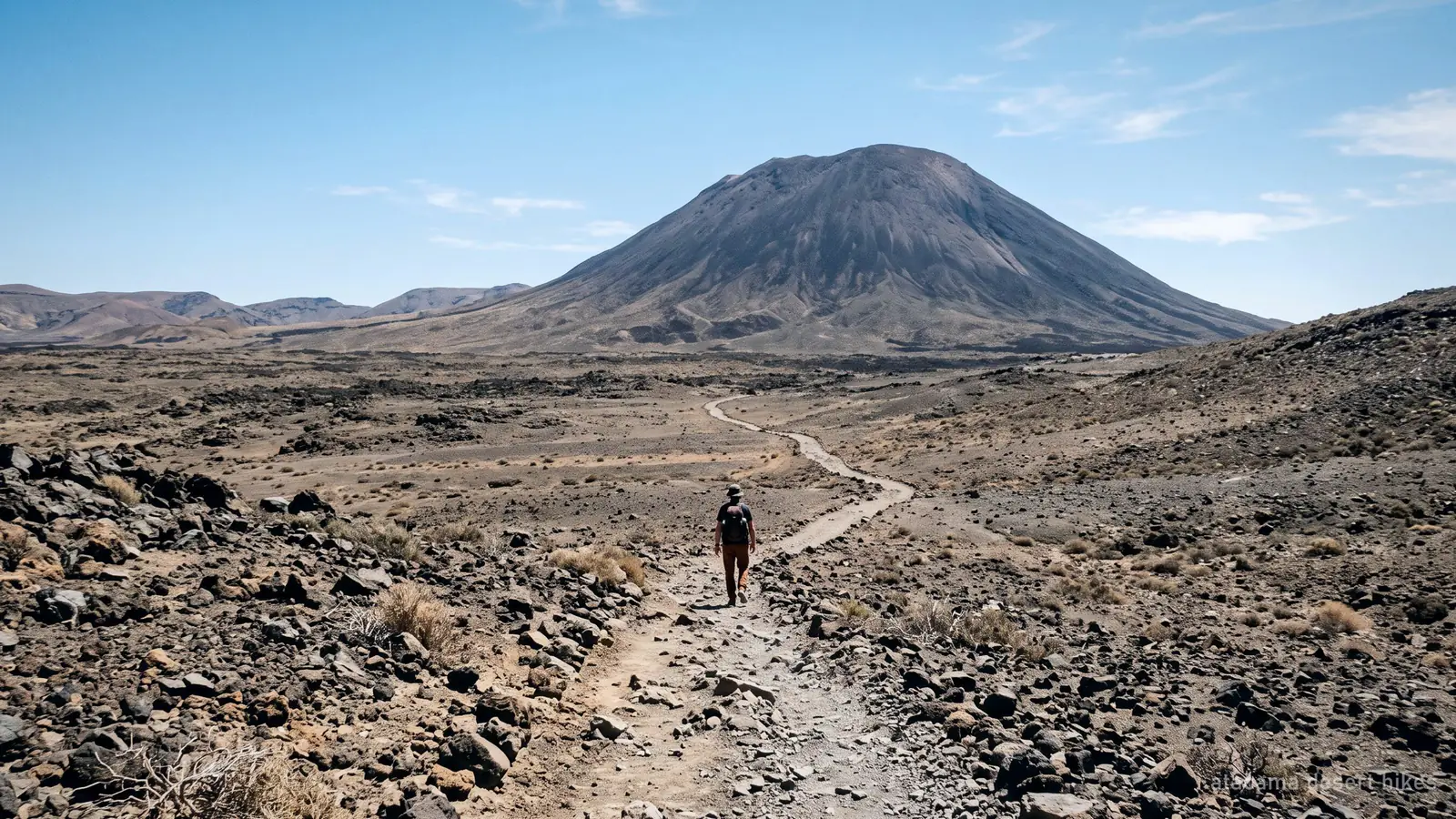
Cerro Toco at about 5,600 m is the accessible one, in the sense that the road reaches 5,200 m and the walk from there is a steep hour on loose scree. It is not technical. It is extremely high, and people who have spent a week acclimatising still turn back on it.
Licancabur, the cone you see from every street in San Pedro, is 5,916 m and sits on the Bolivian border. It is a serious ascent requiring a permit and a guide, and it is not something to decide on while you are here.
Both are guided, both require real acclimatisation, and neither should be attempted in the first days of a trip.
What altitude does to an easy walk
You will be breathless on gradients that would not register at home. Recovery between efforts takes longer. Your legs feel fine and your lungs do not, which is a strange and slightly alarming combination the first time.
The response is to go slowly from the start rather than to push and rest. Walk at a pace you could hold a conversation at. It will feel absurdly slow and it is the correct speed.
What to carry
More water than the distance suggests — humidity between 13 and 38 per cent takes it out of you without registering as thirst. Sun protection that does not depend on shade, because there is none. Something warm for the moment you stop, particularly at height.
And closed shoes with grip: the ground is broken salt crust, loose volcanic gravel and sand, in roughly that order of unpleasantness underfoot.
The altitude page covers the acclimatisation order, and it applies to walking at least as much as to driving up.
Check prices & dates
Book your tickets in advance: popular time slots sell out.
Compare Atacama Tours